
A power outage is inconvenient. A power outage with your car trapped in the garage can stop your whole day. This garage door emergency release guide explains how to disconnect your opener and move the door by hand without creating a bigger repair problem.
The red emergency-release cord is there for a reason, but it is not a fix for every stuck garage door. Used at the wrong time, especially when a spring or cable has failed, it can leave a heavy door unsafe to move. Take a minute to check the door before you pull anything.
What the emergency release does
Your garage door opener pulls the door through a trolley that travels along the opener rail. The emergency release disconnects that trolley from the opener so you can lift and lower the door manually.
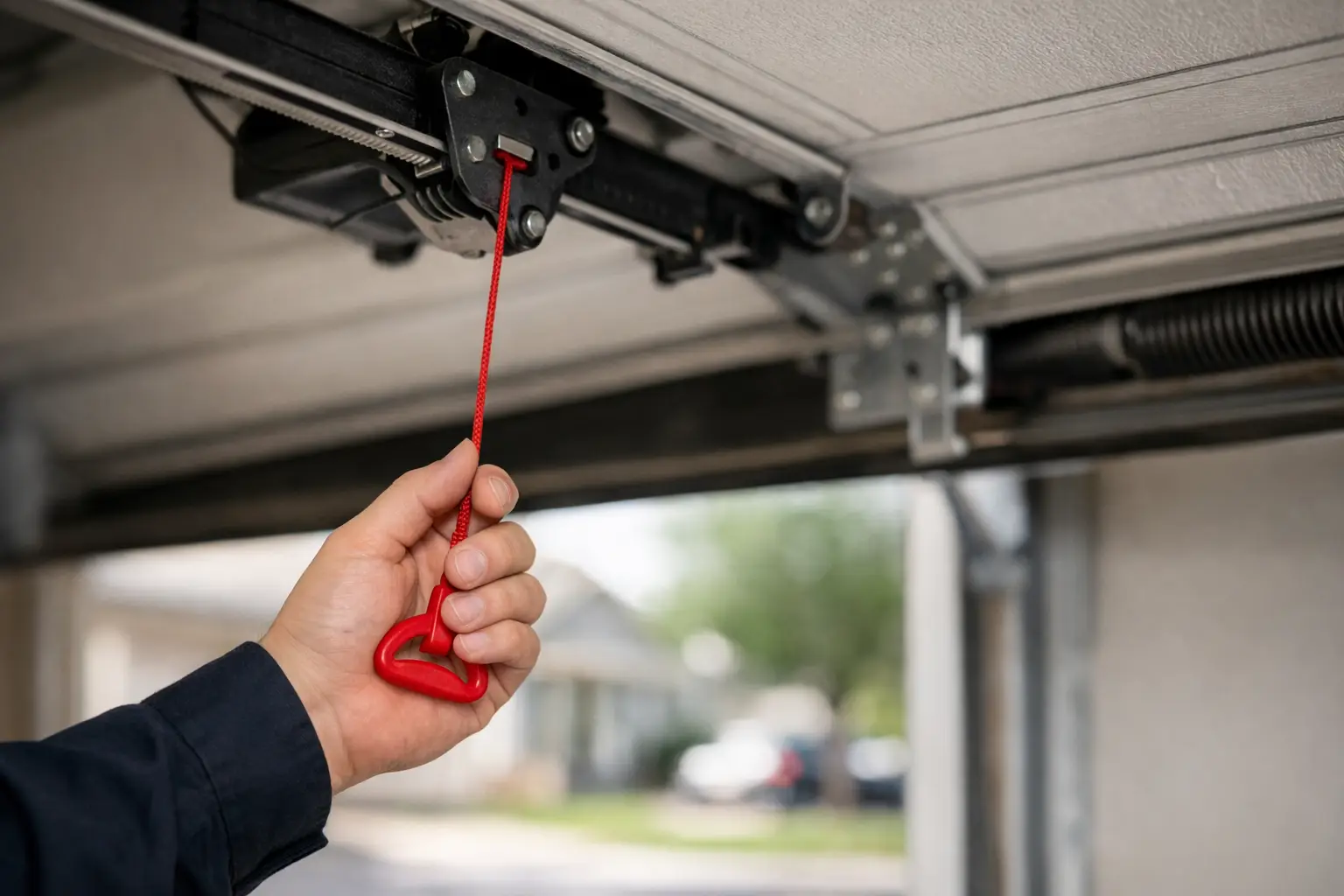
Most residential systems have a short red cord with a red handle hanging from the center rail overhead. Pulling it releases a small latch inside the trolley. The opener is still mounted and powered if electricity is available, but it is no longer connected to the door.
This feature is most useful during a power outage when the garage door itself is in good working condition. It can also help when an opener motor quits, a remote fails, or you need to get a vehicle out before repair service arrives.
Before you pull the red cord, check the door
The safest time to use the emergency release is when the garage door is fully closed. A closed door is supported by the floor, not hanging above your vehicle, family, or belongings.
Do not pull the release when the door is partly open unless there is no safer option and you understand the risk. If a spring is broken, a cable has come loose, or the door is off its tracks, releasing the opener may allow the door to drop or shift suddenly. Keep people and pets clear of the opening.
Look for obvious signs that this is more than an opener problem. A loud bang from the garage, a gap in the torsion spring above the door, loose cables near the bottom brackets, bent tracks, or a crooked door are all reasons to leave the door alone. A door that feels unusually heavy is another clear warning sign. Garage door springs and cables are under high tension and are not a homeowner repair.
If your door has windows, damaged panels, or an impact from a vehicle, do not try to force it open manually. The added strain can bend sections and tracks that might otherwise have been repairable.
How to use the garage door emergency release safely
If the door is closed, appears level, and has no visible broken parts, follow these steps carefully.
1. Turn off the opener if power is on
Unplug the opener or switch off its circuit if the garage has power. This prevents someone from pressing a remote while you are working around the door. During an outage, the opener will already be off, but make sure nobody tries to operate it with a backup battery system.
2. Make sure the door is fully closed
Check that the bottom of the door is resting on the floor. If the door is stuck several inches above the ground, do not pull the release and walk underneath it. Call for service instead.
3. Pull the emergency-release handle down and back
Stand inside the garage, away from the path of the door. Pull the red handle straight down. On many openers, a slight pull toward the back of the garage will disengage the trolley. You may hear a click.
Do not yank the cord hard or pull at an angle. The cord releases a latch. It does not lift the door for you.
4. Lift the door evenly from the bottom
Use both hands near the lower handles or the bottom edge of the door. Lift steadily, keeping your fingers away from hinges, rollers, and track hardware. If the door is balanced correctly, it should move without extreme effort.
Stop immediately if the door binds, moves crookedly, feels too heavy, or will not stay open. Those symptoms often point to a broken spring, damaged roller, track issue, or cable problem. Forcing a heavy garage door can cause injury and more extensive damage.
Once the door is open, make sure it is stable before moving your vehicle. Do not leave a manually opened door unattended for long, particularly in wind. If it starts drifting down, lower it carefully and arrange repair service.
5. Close the door by hand when you are done
Pull the door down evenly until it reaches the floor. Do not slam it. A closed garage door protects your home, especially if the power remains out overnight.
If the door will not close fully, is sitting unevenly, or has a gap at the bottom, avoid leaving it unsecured if possible. Move vehicles and valuables away from the door, and get a technician to inspect the system.
How to reconnect the opener after an outage
After power returns, confirm the garage door is fully closed before reconnecting the trolley. This is the simplest and safest position for most systems.
Plug the opener back in. On many models, you can pull the red release handle down and toward the opener until the latch resets, then run the opener with the wall button. On other models, simply press the wall button and let the moving trolley reconnect when it reaches the release mechanism.
Listen for the trolley to click back into place. Then run one full open-and-close cycle while watching from a safe distance. The door should move smoothly, stop at the proper positions, and reverse when the safety sensors are blocked.
If the trolley will not reconnect, do not keep pulling the cord or repeatedly run the motor. The release mechanism may be in the wrong position, the chain or belt may be loose, or the opener may have a separate problem. A technician can reset it without damaging the opener rail or trolley assembly.
When the emergency release is not the answer
Sometimes a homeowner pulls the red cord and discovers the real problem was never the opener. If the door will not lift manually, the opener is usually not the main issue.
Call for garage door repair when you notice a broken spring, loose or frayed cable, door sections out of alignment, rollers out of the track, a door that hangs crookedly, or grinding and popping noises. You should also call when the door is open and will not come down safely. Do not use clamps, boards, rope, or household tools to hold up a damaged door.
Longmont weather can add another layer to the problem. Frozen weatherstripping may hold the bottom of the door to the concrete, while snow, ice, and debris can block the photo-eye sensors or interfere with the tracks. Clear visible obstructions first, but do not chip ice around cables, springs, or the bottom brackets.
A quick safety habit that pays off
Find your emergency-release cord before an outage happens. Make sure adults in the household know where it is, how to use it only with the door closed, and why a heavy or crooked door needs professional attention. Keep the area beneath the opener rail clear enough to reach the release without climbing on a vehicle or unstable ladder.
A garage door that is balanced and maintained properly is far easier to operate during an emergency. If yours has become noisy, slow, uneven, or unreliable, Repair Bro's can inspect the system and provide a free estimate for the repair needed. The best time to deal with a worn spring, roller, or opener is before your car is stuck inside on a rushed morning.
If the door does not move easily by hand after you release it, trust that signal. Close it if you safely can, keep the area clear, and get the problem checked before the next emergency puts you in a tougher spot.