
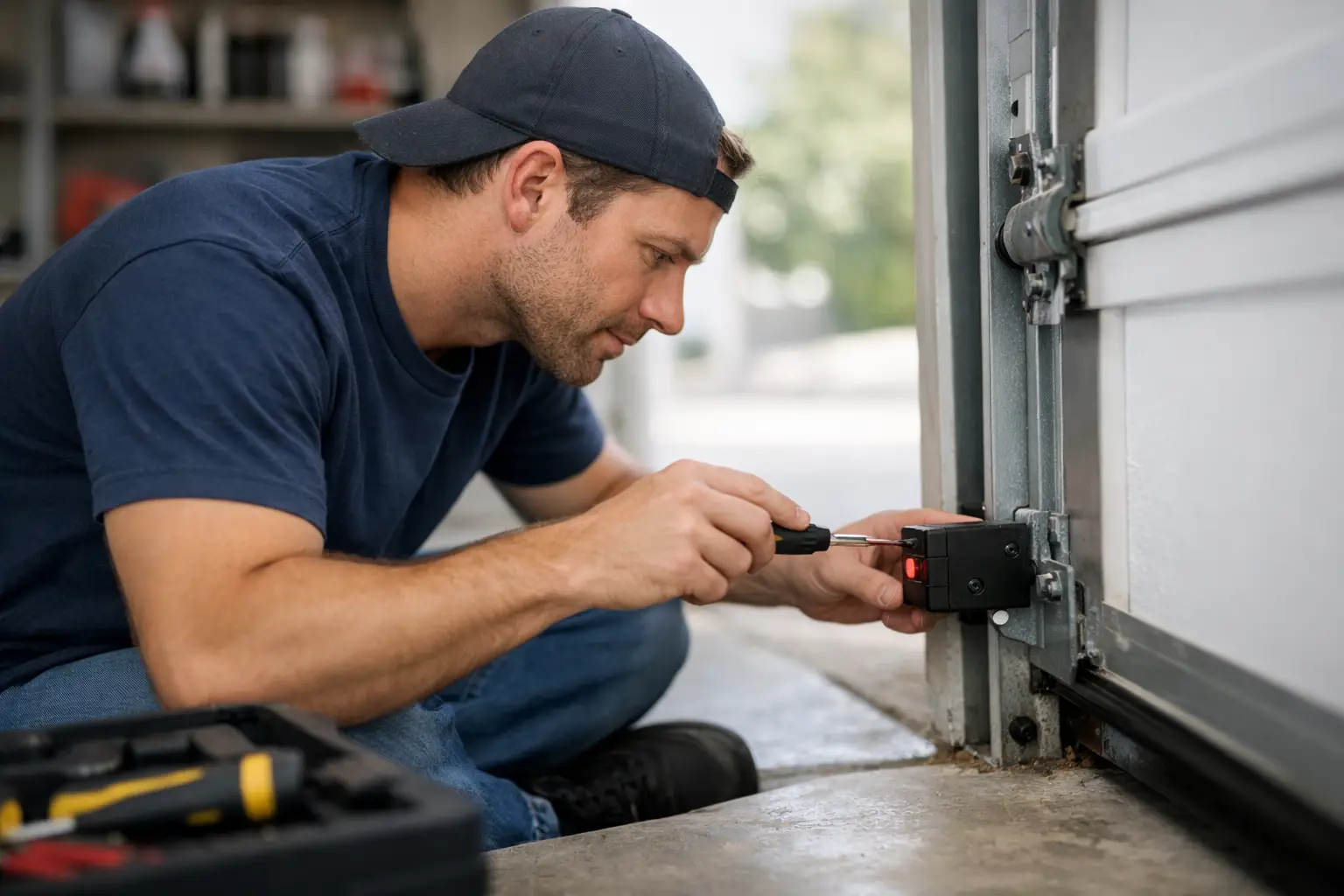
Your garage door starts down, then stops and heads right back up. Or it refuses to close at all unless you hold the wall button. If you're searching for how to troubleshoot garage door sensors, you're probably dealing with one of the most common garage door problems homeowners run into.
Garage door sensors are a safety feature, not just a convenience. They sit near the bottom of both sides of the door track and send an invisible beam across the opening. If that beam is blocked, or if the sensors cannot see each other clearly, the opener may stop the door from closing. That is good when a kid, pet, bike, or trash can is in the way. It is frustrating when the problem is just dirty lenses, loose brackets, or wiring that has worked itself loose.
How to troubleshoot garage door sensors step by step
Start with the simple stuff first. Most sensor issues are basic, and many can be spotted in a couple of minutes without tools.
Look at both sensor units near the floor. If one has been bumped by a broom, a tire, or a storage bin, it may be pointed slightly off. Even a small shift can break the beam. The sensors should face each other directly and sit at about the same height.
Next, check for anything blocking the path between them. Leaves, cobwebs, mud, kids' toys, and even a buildup of dust can cause trouble. Wipe the sensor lenses with a soft cloth. You do not need harsh cleaner. In fact, too much moisture can create its own problems if it gets into the housing.
After that, look at the indicator lights on each sensor. Different brands use different colors, but most systems have one sensor that sends and one that receives. Usually, a solid light means normal operation. A blinking or unlit sensor often points to misalignment, dirty lenses, or a wiring issue. If one light is steady and the other is out or flickering, focus your attention there.
Try closing the door again after cleaning and checking alignment. If it works, the problem was minor. If not, keep going.
Common garage door sensor problems and what they mean
Sensor issues are usually caused by one of a few things. Misalignment is the big one. These brackets sit low to the ground, which means they get kicked, bumped, and rattled over time. If the lights are not solid, gently adjust the sensor until the indicator stays steady.
Dirt is another frequent problem, especially in garages that collect dust, grass clippings, or road grit from vehicles. A lens does not need to be fully covered to cause trouble. A light film can be enough to weaken the beam.
Sunlight can also interfere. This catches people off guard, especially at certain times of day. If direct afternoon sun hits one sensor, it can affect how well the beam is received. This problem may seem random because the door works fine in the morning and acts up later. A small shade adjustment or repositioning can help, but it depends on the setup.
Wiring problems are more serious. The low-voltage wires running from the sensors back to the opener can become loose, pinched, or damaged. If you see frayed wire, cracked insulation, or a wire pulled out of its terminal, that may be the issue. Sometimes rodents chew these wires. Sometimes years of vibration just loosen a connection.
There is also the chance the sensor itself has failed. That is less common than alignment or dirt, but it happens. If you have already checked position, lens condition, and wiring, a bad sensor becomes more likely.
Check alignment without overcomplicating it
If the sensors seem slightly off, adjust them carefully. Loosen the mounting wing nut or bracket just enough to move the sensor, then point it directly at the opposite side. Watch the indicator light while you make small changes. Once the light turns solid, tighten it back down.
This is one of those jobs where patience matters more than force. If you crank the bracket too hard or twist the housing, you can create a new problem. The goal is simple - both sensors should be level, facing each other, and held firmly in place.
If the bracket is bent, alignment may not hold. In that case, straightening or replacing the bracket may be necessary. A lot of homeowners get the light steady for a moment, then the vibration of opening and closing shakes it loose again. That usually points to hardware that is worn or damaged, not just a one-time shift.
When the door closes only if you hold the wall button
This is a classic sensor symptom. On many openers, holding the wall button forces the door to close in override mode. That does not mean the sensors are fine. It usually means the opener is bypassing them because it believes the beam is blocked or the sensors are not communicating.
Use that clue the right way. It helps confirm the issue is likely in the safety sensor system, but it is not a fix. Running the door in override mode regularly is risky because the safety feature is there for a reason.
If this is happening, go back to the sensor checks first. Clean the lenses, confirm alignment, and inspect the wires. If everything looks normal but the problem stays, it is time to stop guessing.
How to inspect garage door sensor wiring safely
Before touching any wiring, unplug the opener if you can do so safely. You are not dealing with high-voltage sensor wire at the sensor itself, but basic caution still matters.
Follow the small wires from each sensor back toward the opener. Look for staples driven too tightly into the wire, cuts in the insulation, loose ends, or corrosion at the terminals. If a wire has come loose at the opener head, reconnecting it may solve the problem. If the copper is damaged, though, a quick patch is not always the best answer.
This is where it depends on your comfort level. Some homeowners are fine tightening a terminal screw. Others would rather not mess with electrical connections over a garage bay. That is a reasonable call. A rushed repair can turn a small issue into an opener problem.
Signs the problem is not the sensors
Not every closing issue comes from the photo eyes. If the door starts down and reverses with solid sensor lights and no obstruction, the opener's force or travel settings could be off. If the door is crooked, heavy, or noisy, there may be a track, roller, spring, or cable problem behind it.
That matters because homeowners sometimes replace sensors when the real issue is elsewhere. If the door has been slamming, sticking, or moving unevenly, the safety system may just be reacting to a mechanical fault. Sensors are one piece of the system, not the whole story.
You should also pay attention if the opener lights flash in a pattern. Some units use blinking codes to point toward a sensor fault, travel limit issue, or internal opener problem. The exact meaning depends on the brand, but repeated flashing after a failed close attempt usually means the opener has detected a safety issue.
When to call for garage door repair
If the sensors will not hold alignment, the wires are damaged, the brackets are bent, or the opener still will not close after basic checks, that is usually the point to bring in a garage door pro. The same goes for any situation where the door is unsafe, partially stuck open, or acting unpredictably.
For homeowners in Longmont, fast service matters because a garage door problem is not just annoying. It affects security, daily routines, and in some cases access to your vehicle. A proper inspection can tell you whether the fix is as simple as sensor replacement or whether another part of the system is causing the trouble.
At Repair Bro's, we see sensor calls that turn out to be loose wiring, sun glare, bent tracks, and opener issues that mimic sensor failure. That is why a clear diagnosis matters more than swapping parts at random.
Prevent sensor problems before they start
A little maintenance goes a long way. Keep the sensor area clear, avoid stacking storage near the track, and wipe the lenses off once in a while. If you sweep or use yard tools in the garage, be aware of where those low-mounted sensors sit.
It also helps to pay attention to small warning signs. If the sensor light flickers now and then, or the door occasionally hesitates before closing, do not ignore it. These problems usually get worse before they get better.
A garage door should close when you ask it to and stop when something is in the way. If yours is doing neither consistently, the smartest next step is the one that gets the problem identified and fixed without wasting your weekend on trial and error.